Those were my daughter Emily’s words that Tuesday afternoon. But I had been her mother for twenty-eight years — I knew the difference between a tired voice and a broken one. Emily’s voice was unsteady, thin, as if she were holding back tears she refused to let fall.
I stood in the kitchen, gripping the counter until my knuckles turned white. “Emily, are you sure?”
“Yes,” she replied too quickly. “I just need to rest.”
Then the line went quiet — not completely silent, just quiet enough for me to hear something in the background. A woman’s voice. Sharp, cold, commanding.
I didn’t hang up. Instead, I grabbed my keys and drove across the city as if I were chasing something terrible before it became irreversible. My heart pounded harder with every mile. Emily was eight months pregnant. She was supposed to be resting, supported, protected. Instead, something in that voice told me she was living in a nightmare she was calling normal.
When I arrived at the house she shared with her husband, Ryan, I noticed the door slightly ajar. That alone made my stomach tighten. Emily never left doors open.
I pushed it and stepped inside.
And froze.
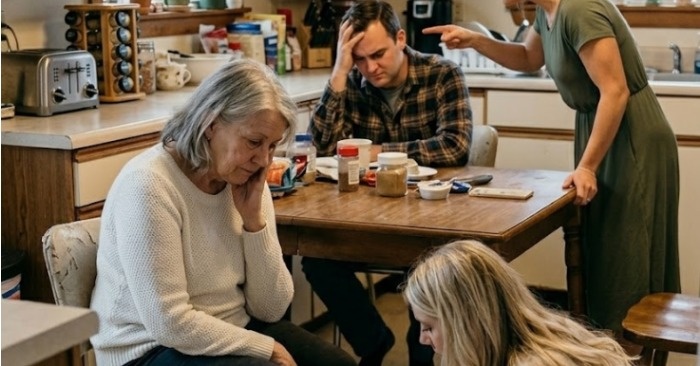
My daughter — my pregnant daughter — was on her knees on the kitchen floor, a bowl of soapy water in front of her, carefully washing her mother-in-law’s feet with a cloth. Her belly pressed against her legs. Her face was pale, exhausted, her eyes red from held-back tears. Standing over her was Diana, Ryan’s mother, sitting back in her chair as if she owned the world. And Ryan? He sat at the table, eating fruit as if none of this concerned him.
For a moment, no one moved.
Then I heard my own voice, quiet but filled with anger. “What… have you done to her?”
Emily looked at me, and the fear in her eyes broke me. She opened her mouth, but before she could speak, Diana scoffed.
“You should have knocked,” she said. “Your daughter is learning how to be a good wife.”
I stood there, unable to believe what I was hearing.
Ryan leaned back in his chair. “Mom’s just preparing her for motherhood. Emily’s been too sensitive lately.”
Too sensitive.
My daughter tried to stand, placing one hand on the floor while holding her back with the other. She winced, and something inside me shattered.
That’s when I noticed it. A dark bruise on her wrist. Fresh.
My breath caught as I stepped closer.
And then Emily whispered, barely audible:
“Mom… please don’t leave me here.”
Everything inside me went cold.
I helped her to her feet quickly, my hands trembling. She was too light, too fragile for someone so far along in her pregnancy. Up close, I saw more — shadows under her eyes, a small cut on her thumb, and the hollow look of someone who had been surviving instead of living.
“She’s not leaving,” Diana snapped, standing up. “This is her home.”
I turned to her, my voice clear but calm. “No. This is a prison.”
Ryan stood, frowning. “Linda, don’t make this dramatic.”
“Dramatic?” A bitter laugh escaped me. “Your pregnant wife is on her knees washing your mother’s feet, and you’re sitting there eating fruit.”
“You don’t understand our arrangement,” he said.
Emily flinched at his words.
That told me everything.
I grabbed her bag from the hook, and Diana stepped forward. “You have no right to interfere in their marriage.”
I moved between her and my daughter. “When my daughter begs me not to leave her here, I have every right.”
Ryan straightened. “Emily, tell her you’re staying.”
Emily looked at him, then at Diana. I saw the fear, the conditioning, the hesitation. Her lips parted, but no words came out.
Diana stepped closer. “Remember what happens when we embarrass this family.”
That was enough.
I pulled out my phone and raised it. “Say one more threatening word,” I said calmly, “and I’ll call the police before you finish the sentence.”
Ryan smirked, but there was no confidence in it. “Police? For what?”
Emily began to cry — not loudly, just quietly, as if her body was finally giving in. “He took my phone last week,” she said. “Said I call you too much. Diana checks what I eat. She said if I gain weight, I’ll be lazy after the baby is born. They make me clean, cook, massage her feet… and if I say I’m tired, Ryan says I’m insulting his mother.”
I looked at Ryan. “Did you touch her?”
He hesitated.
That hesitation was enough.
Emily held her breath. “He grabbed me yesterday when I said I wanted to visit you. That bruise—” her voice broke, “that bruise is from him.”
Diana quickly intervened. “He was restraining her. She gets emotional.”
I had heard enough.
“Emily,” I said gently, “go pack your things. Just the essentials. We’re leaving.”
Ryan stepped into the hallway. “She’s my wife.”
“And she’s my daughter,” I replied. “Step aside — or the next sound you’ll hear will be sirens.”
For a long moment, no one moved.
Then Emily squeezed my hand and whispered, “Mom… there’s more.”
I looked at her face and knew it would be worse.
She led me to the bedroom and closed the door. Her hands shook as she opened a drawer and pulled out an envelope.
Inside were ultrasound images, medical records, and a doctor’s note.
I read them — and felt the blood drain from my face.
“Excessive physical stress.”
“Unstable blood pressure.”
“Strict rest required.”
“Emily… did they know?” I asked.
She nodded, tears streaming down her face. “Ryan was at the appointment. The doctor said I needed rest, low stress, and help.” She let out a short, hollow laugh. “On the way home, Diana said women today are weak. Ryan said his grandmother worked until the day she gave birth.”
I couldn’t speak.
Then Emily said the words that still haunt me.
“Mom, last night I had cramps. Real ones. I told Ryan something was wrong, and he said if I went to the hospital for every pain, we’d go broke. Diana said to drink water and stop being dramatic.”
I grabbed her bag and started packing it. “We’re leaving. Now.”
When we returned to the living room, Ryan’s expression changed the moment he saw the documents. “Emily, don’t do this,” he said, suddenly unsure. “You’re overreacting.”
“No,” Emily said. Her voice still trembled — but now it carried strength. “I’ve lived through this for months.”
Diana stood abruptly. “If you walk out that door, don’t come back when motherhood becomes difficult.”
Emily lifted her chin. “Motherhood became difficult the moment I entered this house.”
I had never been prouder.
Ryan stepped forward — then stopped when he saw me dialing 911.
We left quietly. No shouting. No chaos. Just the three of us walking out while the people who had broken her stood there, realizing they had lost control.
That same evening, I took Emily to the hospital. The doctors admitted her immediately — her blood pressure was high, and she was dehydrated. They said a few more days in that stress could have endangered both her and the baby.
A week later, Emily moved into my home for good. Two months after that, she gave birth to a healthy baby girl named Grace. Ryan called. Apologized. Blamed his mother. None of it mattered. Emily filed for divorce — with evidence, medical records, and the truth on her side.
Today, Grace is two years old. Emily has her own place, a stable job, and laughter in her voice again — real laughter.
And me?
I still think about that half-open door.
Because sometimes abuse doesn’t begin with violence.
Sometimes it starts with control, humiliation, and the slow disappearance of someone’s worth.
So if you ever hear someone say “I’m fine,” but something feels wrong — listen.
Because one decision —
one drive —
one moment of stepping through a door —
can change everything.