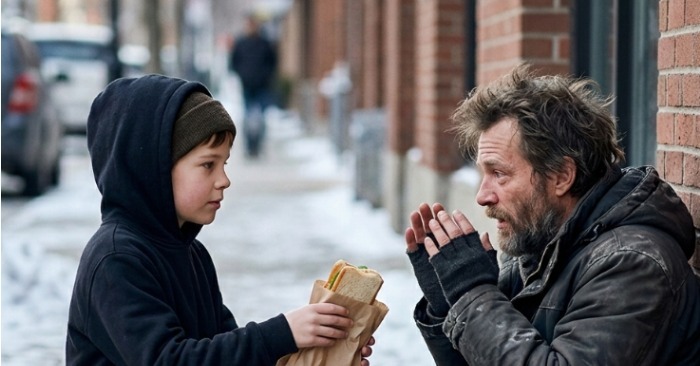
Hunger had always been a familiar companion for Lucas, but that afternoon, it wasn’t his own empty stomach that made him pause.
Lucas was twelve and knew hunger better than most kids in his class. It wasn’t the loud, dramatic kind people see on television. This hunger was quiet and constant.
It distracted him during math lessons while Ms. Patterson wrote fractions on the board. When the school day ended, it followed him home—a hollow ache that refused to let go.
His mother, Irene, worked long shifts at a care home in the city. She left before sunrise and often returned after dark. Her shoulders were always tense, her eyes tired but gentle.
That morning was like many others.
“I’m sorry, sweetie,” Irene said in their small kitchen, wrapping his sandwich in wax paper. “Just a sandwich and an apple today.”
Lucas shrugged and smiled. “That’s fine, Mom. I like your sandwiches.”
She smiled back, but it didn’t reach her eyes. There was barely enough bread for two slices, a little peanut butter left in the jar, and the apple was small and slightly bruised.
She placed the lunch in his worn backpack and kissed his forehead. “I’ll try to make it better next week.”
“You always do,” he replied quietly.
Lucas knew his mother sometimes skipped meals. He pretended not to notice.
That afternoon, the cold was sharper than usual. Winter had settled in early, bringing icy winds that cut through coats and numbed fingers. Lucas pressed his thin jacket tighter around himself as he walked from school toward home.
His breath came out in little white clouds.
His stomach was already twisting. He had saved the sandwich all day. Around lunch, when classmates unpacked chips and traded cookies, he had quietly sipped water instead. He told himself he would eat at home—easier, less embarrassing.
At the corner of Maple Street, he saw him.
A man sitting on the sidewalk by the bus stop bench. Slouched, hands on his knees. His coat was thin, meant for autumn, not the bitter January cold. His hands trembled, red and stiff. Hair streaked with gray, face worn.
People passed by.
A woman in high heels didn’t glance down. A teenager with headphones walked around him without stopping. A man in a suit frowned, as if the sight annoyed him.
Lucas slowed his pace.
He didn’t know why. Maybe it was the trembling hands. Maybe the hunched shoulders, as if the world pressed too heavily on him.
Lucas felt the familiar tug in his stomach.
He thought of the sandwich.
He thought of the apple.
He thought about how long it would be until dinner.
The wind howled down the street, and the man shivered even more.
Lucas stopped.
For a moment, he just stood there. The backpack straps dug into his shoulders. His heart thudded in his ears. He was only twelve. He didn’t have much. Barely enough.
He swallowed.
Then he stepped closer.
Up close, the man looked even more exhausted. But his eyes were sharp. When Lucas approached, he looked up.
Lucas hesitated, then slowly unzipped his backpack. Fingers stiff from the cold, he carefully unwrapped the sandwich halfway.
He looked at it.
Then at the man.
Without a word, he sat down beside him and held out the sandwich. “You look like you need this more than I do,” he said softly.
Even he was surprised by the words. They came out calmly, though his stomach ached painfully.
The man looked at him for a long moment before taking it.
Their eyes met. Lucas suddenly felt small, sitting there in the cold. A dozen worries ran through his mind. What if the man refused? What if he laughed? What if he shooed him away?
But the man did none of those things.
His trembling hands slowly took the sandwich, as if it were fragile.
“Thank you,” he said, rough but sincere.
Lucas nodded. He placed the apple beside him. “You can have this too,” he added.
For a moment, no one spoke. The city sounds surrounded them. Cars passed, a dog barked somewhere.
The man took a bite.
Lucas smelled the peanut butter in the cold air. His stomach twisted so sharply he felt dizzy. He pressed his palms against his knees and focused on breathing.
He told himself it was okay.
He would drink water at home. He would wait for dinner. Maybe there would be soup.
“Why?” the man asked suddenly.
Lucas blinked. “Why what?”
“Why did you give it to me?”
Lucas shrugged, looking at his shoes. “You looked cold.”
The man studied him again. Longer this time. There was something in his eyes Lucas couldn’t quite understand. It wasn’t pity, nor amusement. It was something deeper, weighty with meaning.
Lucas flushed under the attention.
He wasn’t used to adults looking at him like that.
“That was very kind of you,” the man said quietly.
Lucas didn’t know how to respond. “Kind” felt like a big word. He didn’t feel kind. He felt hungry.
He stood, brushed the dust from his jeans. “I have to go.”
The man nodded. “Take care.”
Lucas waved lightly and walked on, before his resolve could falter.
When he reached the apartment, his steps felt heavy. The hallway smelled faintly of bleach and old carpet.
Inside, the apartment was quiet, bathed in half-light.
He poured a glass of water and drank slowly. Then another.
He did his homework at the kitchen table, trying not to think about food. Numbers blurred a few times, but he blinked and the feeling passed.
When Irene came home that evening, she looked more tired than usual.
“How was school?” she asked, removing her shoes.
“Fine,” Lucas replied automatically.
She glanced at his backpack. “Did you eat your lunch?”
He hesitated for a moment, hoping she wouldn’t notice.
“Yes,” he said.
It wasn’t a lie. He hadn’t brought the food back.
That night, his stomach ached so badly he couldn’t sleep. He turned on his side, staring at the cracked paint on the wall. He told himself it didn’t matter. It was just a sandwich.
He didn’t know the whole situation had been a test.
The next morning, Irene woke him earlier than usual. Her voice was soft, almost careful.
“Lucas,” she said, lightly touching his shoulder. “Wake up.”
He blinked, confused.
The room was still dim in the early light.
“There are people who want to see you,” she said quietly. “We want to talk to you.”
Lucas sat up, heart racing, unaware that his small, quiet choice from yesterday would change everything.
“People?” he repeated, pushing hair from his eyes. “What people?”
Irene looked at him in a way he had never seen. Not fear. Not excitement. Careful. Almost protective.
“They’re waiting in the living room,” she said. “Just get dressed.”
His stomach twisted again, but this time not from hunger. Lucas quickly put on his jeans and sweater.
His mind raced through every possible mistake.
Had he forgotten an assignment? Broken a rule at school? Was this about something he didn’t even realize?
When he stepped into the living room, he almost froze at the doorway.
The man from the sidewalk stood by the window.
But this time he didn’t look the same.
He was no longer hunched or shivering. Dressed in a thick wool coat, polished shoes, and a neatly pressed shirt. His gray hair combed back, posture straight. Beside him stood a woman in a navy coat holding a folder, and another man in a suit closer to the door.
Lucas felt his face heat up.
The man’s eyes met his. This time there was no exhaustion. There was recognition.
“Good morning, Lucas,” the man said softly.
Lucas looked at his mother. “Mom?”
Irene stepped forward, placing her hand on his shoulder. “It’s okay,” she whispered.
The man took a step forward. “My name is Elijah,” he said. “And I need to explain something.”
Lucas swallowed but said nothing.
Elijah nodded toward the sofa. “May we sit?”
Everyone sat. Lucas perched on the edge, fingers gripping his knees.
“Yesterday afternoon I saw you on Maple Street,” Elijah began.
Lucas’s chest tightened. “I was cold,” he said quietly.
“Yes,” Elijah agreed.
There was a pause before he continued.
“What you did yesterday wasn’t random,” he said carefully. “I work for a foundation. We help families in difficult situations. Sometimes we quietly observe communities. We try to understand who people really are when no one is watching.”
Lucas frowned slightly.
“You observed people?”
“In a way,” Elijah replied. “We were looking for kindness. True kindness. The kind that costs something.”
The words hung heavy in the room.
Lucas felt his mouth go dry. “It was just a sandwich.”
Elijah’s gaze softened. “It wasn’t just a sandwich. I was there for almost two hours. Dozens of people walked past. Some noticed, most did not. You were the only one who stopped.”
Lucas looked at the floor.
“You didn’t know anyone was paying attention,” Elijah continued. “You didn’t know there would be a reward. You just saw someone who looked cold and hungry.”
Lucas flushed.
“I just figured you needed it more than I did,” he said quietly.
Irene’s hand pressed lightly on his shoulder. He could feel her trembling.
Elijah pointed to the woman with the folder. She opened several documents.
“We looked into your situation,” Elijah said. “We learned about your mother’s long shifts. How hard it is for her to care for you. That some days there is barely enough for both of you.”
Lucas’s face burned. He hated the idea of strangers knowing this.
Irene took a shaky breath. “We didn’t ask for help,” she said softly.
“I know,” Elijah replied. “That’s part of why we’re here.”
He leaned forward, voice steady.
“Lucas, yesterday was a test. Not for wealth. Not for appearances. A test of character. You passed in a way few could.”
The word “test” echoed in Lucas’s mind.
He remembered the cold on the sidewalk. The ache in his stomach. The smell of peanut butter. How he decided the man needed it more.
“I’m walking home hungry,” Elijah said quietly.
Lucas’s eyes widened. “How did you know?”
Elijah looked at him with understanding. “Because you gave everything you had.”
Silence filled the room.
“Our foundation wants to help your family. Immediately. Rent for the next two years will be covered. Your mother will receive support to reduce her hours and care for you without worry. And when the time comes, there will be a separate fund for your education.”
Lucas blinked, certain he had misheard.
“Two years?” Irene whispered.
“Yes,” confirmed the woman with the folder, sliding the papers across the table.
Lucas looked at his mother. Her eyes were wide, glistening with tears she tried not to shed.
“This is because… of the sandwich?” Lucas asked quietly.
Elijah shook his head.
“No. Because that’s who you are.”
Lucas felt a change inside him. For a long time, he thought being small meant powerless. Being poor meant invisible. But yesterday, sitting on the cold sidewalk, he hadn’t felt small. He had felt certain.
“I didn’t do it for that,” he said calmly, despite the storm of emotions.