I’m 34 years old and I live in the United States. Until last year, my life was completely ordinary.
I worked as a paralegal. I lived in a small apartment. Every Saturday, I grabbed coffee with my best friend Jenna.
Then my older sister Erin died in a car accident while driving home from work.
One second she was sending me a stupid meme, and the next I was standing in a hospital hallway listening to a doctor say:
“We did everything we could.”
Erin had two daughters.
Maya, who was 8, and Lily, who was 6.
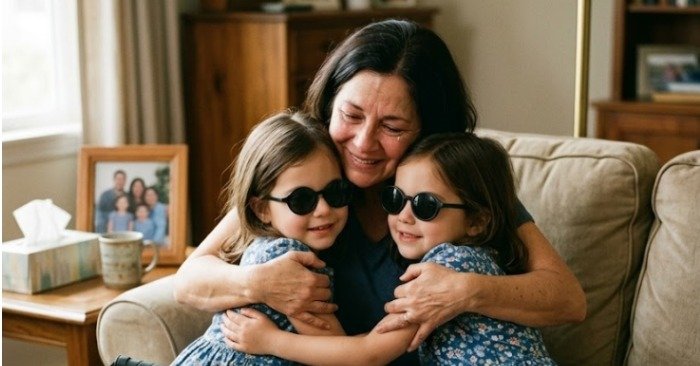
Both girls had been legally blind since birth.
We lived two hours apart, so I didn’t see them often, but I knew their voices. I knew Lily’s laugh and the way Maya asked questions like a tiny lawyer.
Their father, Derek, never showed up.
At the funeral, the girls stood beside the casket, clutching Erin’s scarf with their fingers tangled tightly in the fabric.
When I said:
“Hi, sweetheart, it’s Aunt Amanda.”
Both of them turned toward my voice instantly.
“Auntie?” Maya whispered. “Is Mom really gone?”
“Yes, baby,” I said softly. “She’s gone.”
Later, a social worker pulled me aside.
I wasn’t surprised. Derek had vanished from their lives years ago. Erin used to say:
“He’s nothing but DNA on a birth certificate.”
Then she would immediately change the subject.
The social worker’s name was Mrs. Ramirez. She was calm, exhausted-looking, and carrying a thick folder.
“We need to discuss placement for the children,” she said. “Derek voluntarily terminated his parental rights three years ago. There are no other relatives listed in the paperwork. Would you be willing to take the girls?”
I looked over at Maya and Lily sitting on folding chairs, shoulders and ankles pressed together like they were afraid someone would separate them if they let go of each other.
“Yes,” I answered before my brain could start screaming about money, space, and how unprepared I was.
That was how I went from being a single woman to becoming a mother overnight.
People think blindness only means not being able to see.
What it really means is needing a system for absolutely everything.
How many steps there are from the couch to the bathroom. Where every chair leg is. What the refrigerator sounds like at night. When you need to say “coming in” so you don’t scare them.
During the first week, Lily slammed her knee into the coffee table and burst into hysterical tears.
“I hate this house!” she sobbed. “Everything hurts me here!”
I sat down on the floor beside her.
“I hated it when I first moved in too,” I told her. “We’ll learn it together, okay?”
We had hard days.
I put protectors on every sharp corner. With help from a library volunteer named Chris, I labeled cabinets and drawers in Braille. I worked with their orientation instructor, Mr. Jonas, so they could memorize the layout of the apartment.
“Door,” I would say while guiding their hands.
“Door,” they repeated.
Maya started calling me “Auntie.” Lily would press her forehead against my shoulder whenever she felt overwhelmed.
Every Saturday, we made pancakes.
I helped them crack eggs and hold the spatula.
“Did shells fall in?” Lily would ask.
“Only one tiny piece,” I’d answer. “We’ll pretend it’s extra calcium.”
A year later, we finally had a rhythm.
School. Therapy. Walks. Bedtime stories.
The girls knew every inch of the apartment by touch. They could recognize my shoes from the neighbors’ shoes just by the sound.
We were still grieving, but it finally felt like we were beginning to heal.
Then one random Tuesday, I came home from work, unlocked the door… and froze.
There was a man sitting in my living room.
His feet were on my coffee table. His arm stretched lazily across the back of my couch. He wore a smug grin.
Next to him sat a man in a suit carrying a leather briefcase.
My neighbor, Mrs. Hensley, stood near the kitchen nervously twisting a dish towel in her hands.
“Amanda… I’m so sorry, sweetheart.”
“Mandy,” the man smirked. “Long time no see.”
Derek.
I recognized him from old photos and one awful Thanksgiving years ago.
My nieces sat stiffly on the opposite couch, knees touching, hands folded tightly in their laps. No canes. No backpacks. No favorite snacks.
Just tense little bodies.
“Hi,” I said carefully, keeping my eyes on them. “Maya. Lily. I’m home.”
Normally they turned toward my voice and relaxed immediately.
This time, Maya’s face hardened.
“You’re a liar!” she exploded.
The words sounded horrifyingly unnatural coming out of her mouth.
I felt them hit me like a slap.
“Stop pretending you’re nice!” Lily shouted.
“She doesn’t take care of us,” Maya said. “She’s never here. She doesn’t feed us. She screams at us all the time.”
Those words didn’t sound like hers. They were too mature. Too sharp.
Derek leaned back and watched me.
“See?” he said to the suited man. “Exactly what I told you. She hates them. I want my daughters back. Write everything down.”
“I’m Mr. Hall,” the attorney introduced himself. “Derek hired me to explore the possibility of restoring custody. The children have shared serious concerns.”
“Mrs. Hensley?” I asked quietly.
She twisted the towel harder.
“He said he was their father. I remembered him from before. I thought it would be good for the girls to see him. I didn’t know he brought a lawyer. I’m sorry, Amanda.”
Derek stood up.
“We’re stepping outside for a smoke. Give Mandy a minute to calm down so we can talk like adults.”
The second the door clicked shut behind them, I dropped to my knees in front of the girls.
“Hey… it’s just me now. Why are you saying those things? What happened?”
Maya’s chin trembled. Lily immediately started twisting her fingers — her nervous habit.
“He said it was a game,” Maya whispered.
“A candy game,” Lily blurted out. “We had to pretend you were bad, and then he’d give us candy. We had to do it every time the man with the notebook was here.”
My stomach twisted violently.
“He told you to lie and say I don’t feed you and that I yell at you?”
Both girls nodded.
“We’re sorry,” Lily whispered. “We didn’t want to hurt you.”
I took a slow breath.
“You didn’t do anything wrong,” I told them. “Do you hear me? Nothing. He’s the adult. Adults are not supposed to make children lie for candy. This is his fault.”
Maya whispered:
“Are you mad?”
“I’m mad at him. Not at you. Never at you.”
I hugged them, kissed the tops of their heads, and stood up.
I needed more than my word against his.
I walked into the storage room.
It was basically a closet stuffed with plastic bins.
I shut the door behind me and leaned against it for two seconds just to stop myself from falling apart.
Then I started digging.
One bin was labeled: “Erin — Documents.”
Inside were copies of everything: Derek’s signed termination papers, court documents, emails, notes from social services.
On the top shelf sat the baby monitor camera I had used when the girls first moved in and kept waking up screaming from nightmares.
I plugged it into the outlet near the coat rack, angled it toward the living room, opened the app on my phone, and hit record.
Then I texted Mrs. Ramirez:
“Emergency. Derek is here with a lawyer. He coached the girls to lie and say I neglect them. Please come immediately.”
She replied almost instantly:
“On my way. Do not force him to leave. Document everything.”
When I walked back into the living room, Derek and Mr. Hall had already returned.
“Alright,” the lawyer said. “Let’s sit down and have a calm conversation.”
Fifteen minutes later, there was a knock at the door.
Derek instantly switched into “concerned father” mode.
He said he had “made mistakes,” but regretted giving up his parental rights. He claimed he had “learned” that I was abusing the girls.
“Children don’t lie about things like that,” he declared.
I glanced at the tiny red light glowing on the camera.
Then I opened the door.
Mrs. Ramirez stepped inside looking calm and professional.
“Hello, Maya. Hello, Lily.”
The girls visibly relaxed when they heard her voice.
Then she turned toward Derek and the attorney.
“I understand we’re discussing custody.”
“That’s right,” Derek said. “I want my daughters back. She’s just their aunt.”
Mrs. Ramirez opened her folder.
“This is the voluntary termination of parental rights that you signed,” she said, sliding the document toward Mr. Hall. “Signed three years ago. No contact since then. No child support paid.”
Mr. Hall slowly looked at Derek.
“You told me you were forcibly removed from their lives.”
Derek shifted uncomfortably.
“They lied—”
“And this,” Mrs. Ramirez continued, tapping another folder, “contains school reports, therapy records, and home visit evaluations. They show exceptional care and tremendous progress since Amanda took custody.”
Then she looked him directly in the eyes.
“I also understand you instructed the girls to lie in exchange for candy, specifically in front of your attorney. That is manipulation and emotional abuse. I will be filing a formal report.”
The entire atmosphere in the room changed.
Mr. Hall snapped his notebook shut.
“Is that true?” he asked Derek.
“They’re kids! They got confused! She’s turning them against me—”
“We’ll be taking official statements from the girls,” Mrs. Ramirez interrupted.
Then she looked at me.
“Do you have evidence?”
I showed her the app on my phone.
“Video and audio.”
Mr. Hall stood up and clicked his briefcase closed.
“We’re done here,” he told Derek. “Do not contact my office again.”
“You can’t just walk away!” Derek hissed.
“You lied to me and used your own children,” the attorney replied. “Yes, I absolutely can.”
He nodded politely toward us and left.
Derek stared at us with pure hatred.
“This isn’t over. You stole my daughters.”
“No,” I said calmly. “You gave them up yourself. I simply took them in.”
He muttered a curse under his breath and slammed the door behind him.
The second it shut, Lily burst into tears.
“I’m sorry! I’m sorry I said you don’t feed us! You make us pancakes!”
Maya started crying too.
“We thought he wanted us. We thought if we didn’t play the game, he would leave again.”
I sat between them and pulled them tightly against me.
“You wanted your dad to love you. That doesn’t make you bad. What he did was wrong. None of this is your fault.”
After that, I locked everything down.
Passwords at school and daycare. Only me or Mrs. Ramirez could pick them up. I changed the locks.
Mrs. Hensley showed up later with cookies and watery eyes.
“I’m so sorry. I thought I was helping.”
“We know better now,” I told her. “Nobody comes into this apartment again without my permission.”
Life didn’t suddenly become easy.
For a long time, whenever someone knocked on the door, Lily grabbed my wrist tightly.
“Remember?” I’d remind her. “Nobody comes in unless I say so. You’re safe.”
She would nod and slowly exhale.
Six months later, we went back to court for something all of us wanted:
The adoption.
The judge asked the girls:
“Do you want to stay with Amanda?”
Maya squeezed my hand.
“She already feels like our mom.”
Lily nodded seriously.
“She knows where all our stuff is.”
The judge smiled warmly.
“That sounds like the perfect family.”
We signed the papers and walked out with the same last name.
Now when I come home and call out:
“I’m home!”
Two tiny voices yell from the couch:
“Mom!”
Sometimes “Auntie” still slips out and we all laugh.
Derek never came back.
But if he ever does, he won’t find a frightened aunt wondering whether she’s enough.
He’ll face a mother who already proved she is.