The animal shelter buzzed with its usual chaos that afternoon — dogs barking from every corner, cats meowing behind metal cages, and volunteers calling out to one another over the clatter of doors and leashes.
And yet, amid all that noise, one quieter, steady rhythm stood out: tap… tap… tap — the sound of a white cane touching the floor. It was followed by the soft scrape of a chair and the curious voice of a young girl asking questions about animals she couldn’t see, yet imagined more vividly than most people ever could.
Emma was twelve years old. Three years earlier, an illness had slowly taken her sight — piece by piece. First came the blur, then distorted shapes, and finally — one morning — nothing. The world slipped into darkness without warning. There were tears, anger, and fear. But over time, she learned to understand in a different way — how footsteps tell stories, how the air shifts when someone enters a room, how emotions can be felt through the rhythm of a breath. Emma no longer saw with her eyes. She had learned to listen with her heart.
That day, her mother had brought her to the shelter to meet therapy dogs. The idea was simple — to find a calm companion, a gentle presence who could walk beside Emma at school and help her feel safe, less alone. A friendly dog. A safe choice. That was the plan.
One by one, volunteers introduced her to eager dogs. Wet noses nudged her hands. Tails thumped against the floor. Collars jingled, and tongues brushed her fingers in bursts of excitement. Emma smiled politely, petted each one, and listened carefully. But something was missing. None of them held her attention for long.
Then she heard it.
A deep, steady sound — heavy and controlled — coming from the end of the hallway. A growl, but not wild or chaotic — more like thunder locked behind steel. The shelter seemed to quiet. Emma turned toward the sound and frowned slightly.
“What about that one?” she asked, lifting her cane and pointing down the corridor. Her mother immediately tensed, gripping her shoulder.
“Sweetheart… no,” she said softly. “Not him. He’s a former police dog. He’s dangerous.”
Emma tilted her head, listening more carefully. This wasn’t anger. It was something broken. Something hurt.
“He doesn’t sound dangerous,” she said calmly. “He sounds scared.”
Then she added, “Mom… I want to talk to him.”
The volunteers exchanged uneasy glances. No one had ever said that before. “Talk to him.” Duke was known for warnings, not invitations. A problem. A risk. A dog to avoid. And yet this girl — who couldn’t see his teeth or his scars — spoke as if she already understood him.
Slowly and cautiously, they led her down the corridor to the last cage. No one spoke their fear, but everyone felt it. This could go wrong. Very wrong. No one considered that it might change everything.
Duke had once been a legend.
For years, he served in a K-9 unit — tracking criminals, finding missing people, protecting his handler with unwavering loyalty. His name was spoken with respect. Until one night, everything fell apart. Smoke. Sirens. An explosion. His handler fell, and in the chaos that followed, Duke’s world shattered. Panic replaced training. Instinct drowned out commands. When they tried to restrain him, he lashed out — not from malice, but from confusion.
From that moment on, he was labeled unstable. Dangerous. Unfit.
He was removed from duty, stripped of purpose, locked behind steel with a red sign warning everyone to stay away.
Every day he curled into the corner of his cage, growling at anyone who passed, as if daring the world to hurt him again. His eyes — once sharp and proud — had dimmed. He wasn’t living. He was surviving.
Until he heard her.
Tap… tap… tap.
Not heavy boots. Not hurried volunteer steps. Something lighter. Careful. And a voice that carried no command — only curiosity.
When Emma stopped in front of his cage, Duke lunged forward. Muscles tense. Teeth bared. The volunteers froze.
“Hi, Duke,” Emma said softly, speaking his name like something precious.
“It’s okay… I’m here.”
No one had spoken to him like that in a long time.
Emma leaned slightly closer and listened.
“He sounds angry,” she said after a moment.
“But… I think he’s actually scared.”
And in that instant, the growling softened — just enough for everyone to realize something extraordinary was happening.
Her mother gripped the back of a chair.
“Emma, you heard him. He’s dangerous. They told you. Don’t go closer.”
Emma spoke calmly, as if disarming everyone in the room.
“Mom, I can’t see his teeth or his face. But I can hear his heart. And it sounds… lonely.”
Duke gradually stopped growling. His breathing shifted. His ears lifted. He didn’t understand her words, but he understood the tone — no threat. It felt like before, when his partner would sit beside him after a mission and say, “Good job, boy. It’s okay.”
“You don’t know this,” Emma continued, “but I can’t see either. Everyone says you look dangerous… but all I hear is that you’re sad.”
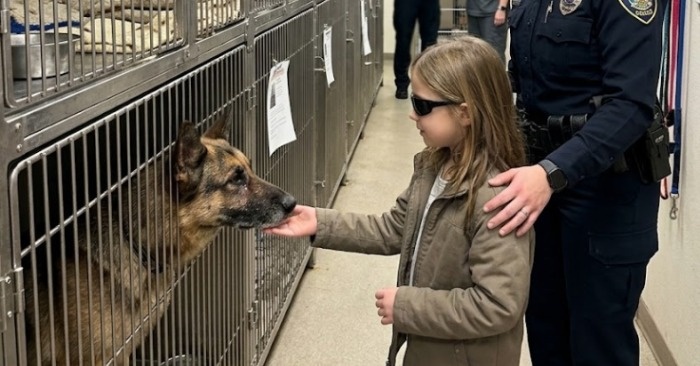
Silence filled the space. Duke’s breathing quickened. His claws scratched against the floor. Emma slowly reached her hand toward the bars. It trembled, but she didn’t pull back.
“It’s okay, Duke,” she whispered. “You don’t have to be afraid either.”
The volunteers gasped when he stepped forward. He sniffed the air. He could sense her fear — but also something else. Warmth. Trust.
His nose touched her fingers. Emma held her breath. Then, slowly, he lowered his head and placed it into her palm.
No one could believe it. He had never let anyone touch him.
“You’re not a bad dog, are you?” she whispered. “You just miss your person.”
Duke let out a soft sound — somewhere between pain and relief.
From that day on, Emma began visiting him almost every day. She read to him, talked to him, shared her fears. And he listened. Soon, he began waiting for her. His tail would move slightly.
Three weeks later, everything changed. The cage door opened. Duke didn’t run. He went to her.
Then he was trained. He became her guide dog.
And one morning, he saved her when a car ran a red light. That’s when everyone understood.
Two lost souls had found their way to each other.
And the world that once called them broken — finally saw them for who they truly were.