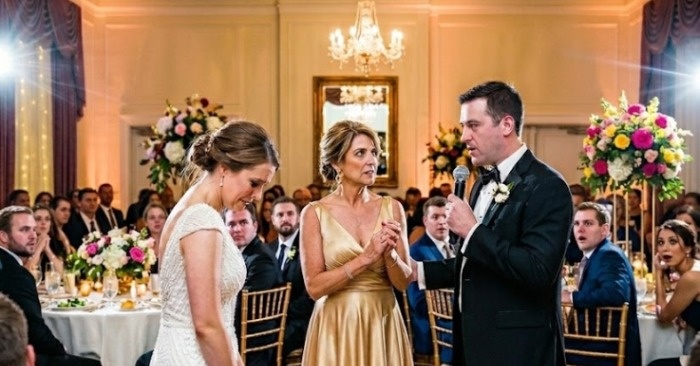
The sound of the string quartet seemed to dissolve around me, as if someone had quietly submerged it underwater, leaving only a distant, hollow vibration echoing behind my temples, because there are moments when humiliation doesn’t arrive as a sharp noise, but as a suffocating silence that swallows everything you once believed in. Just a minute earlier, I had been standing beneath an arch of white roses at a historic estate overlooking the Hudson River, my veil resting lightly on my shoulders, my father’s hand still holding mine with that warm certainty that had guided me through every important threshold in my life. I believed, with that complete trust only love can create, that I was stepping into something lasting.
The next minute, that certainty vanished so completely that I felt as though I was standing inside the hollow shell of a life that had already collapsed.
The head table — our table, the place where the people who matter most were supposed to sit — was filled with strangers whose names I barely knew, people whose importance was measured in business partnerships, investment value, and social status. Meanwhile, my parents, who had given everything so I could stand in that room with confidence, had been quietly moved to the back of the hall, among guests categorized as peripheral, decorative, or easily forgotten.
I turned to Nathan Caldwell, the man I had loved for two years, and for a moment I searched his face for the Nathan I thought I knew, the one who had once promised that nothing external would ever outweigh what we had built together. He looked composed, dressed in a tailored suit, but something in his stillness felt unfamiliar, as if the man I trusted had been replaced by someone who knew exactly what was happening and had chosen to allow it.
I reached for his hand, my voice quieter than I expected.
“Nathan,” I said, “what does this mean? Where are my parents’ seats?”
Before he could answer, his mother, Margaret Caldwell, appeared beside us, carrying that flawless confidence that had never once been questioned. She wore champagne silk and a perfectly practiced smile that never reached her eyes.
She placed her hand lightly over mine, a gesture that might have looked affectionate to anyone who didn’t understand the calculation behind it.
“Emily, dear, don’t look so worried,” she said calmly. “It’s just a small adjustment. These things happen when guest dynamics shift at the last moment.”
I held her gaze, refusing to soften the moment into something polite.
“An adjustment?” I asked. “You moved my parents from the head table.”
She tilted her head slightly, as if explaining something obvious to a child who was being overly emotional.
“Listen, dear,” she said, lowering her voice just enough to sound considerate while still delivering the message, “it’s not personal. The head table needs to reflect a certain… presentation. Some guests are very particular about appearances, and it’s simply more convenient for everyone if people sit where they best fit the setting.”
There it was — the language of hierarchy disguised as etiquette.
She leaned closer, her tone softening, which only made it sharper.
“Your parents are lovely people,” she continued, “but they’re not accustomed to this social circle. Their presence there might… disrupt the image we maintain.”
I turned to Nathan, waiting, hoping he would correct what had just been said, that he would stand up and show the difference between loyalty and convenience.
“Tell her she’s wrong,” I whispered. “And bring two chairs here. Now.”
He sighed, as if I had asked for something unreasonable.
“Emily, don’t make this a big deal,” he murmured. “My mom isn’t entirely wrong. Where they sit doesn’t change anything. We’re married now, and everything else is just… details.”
Details.
The word settled into my chest like something cold and permanent.
Then my mother stepped closer, her smile fragile but determined, her voice trembling just enough for me to hear the effort behind it.
“Don’t worry about us, sweetheart,” she said softly. “No matter where we sit, what matters is that you’re happy.”
That was the moment everything shifted.
Not when Margaret spoke.
Not when Nathan failed to defend me.
But when my mother, who had taught me dignity my entire life, tried to make herself smaller so I wouldn’t have to fight.
The silence brought clarity, and when I smiled, it was no longer uncertain.
“You’re right, Nathan,” I said.
They relaxed immediately, mistaking my calm for surrender.
They didn’t realize I had already chosen something else.
The speech that refused to be polite
I walked to the back of the hall where my parents were seated and took their hands with a firmness that even surprised me.
“Trust me,” I whispered.
Then I turned toward the stage, where my best friend, Sophia Grant — the most relentless attorney I had ever met — was coordinating the flow of the event. When she saw my expression, she didn’t ask a single question. She simply handed me the microphone.
I took a deep breath and faced the room.
“Before dinner is served,” I began, “I’d like to make a toast.”
The conversation faded.
Glasses paused midair.
Nathan straightened, tense.
“A toast to truth,” I continued, lifting my glass. “Because the version of this wedding day I believed in ended about five minutes ago.”
A ripple moved through the guests.
Nathan turned toward me, his voice tight with concern.
“Emily, please, don’t do this here.”
I didn’t raise my voice, but I didn’t stop.
“Five minutes ago,” I said, “my husband told me it wasn’t worth ruining the evening over where my parents were seated. His mother explained that my parents didn’t belong at the head table because they didn’t match the image their family maintains.”
I slowly scanned the room, letting the words settle where they needed to.
“For two years, I watched this family measure people by profession, background, and their ability to perform a version of refinement that has nothing to do with character. You criticized my father, diminished my mother’s career, and tried to shape me into something more convenient for your expectations.”
Nathan’s voice cracked.
“Emily, I’m sorry,” he said. “It was a mistake.”
I shook my head.
“No,” I replied. “A mistake is choosing the wrong song. This is a decision.”
Margaret’s composure fractured.
“You’re ungrateful,” she snapped.
I inhaled quietly, no longer angry — only certain.
“You built everything around appearances,” I said. “You can keep that. I choose my dignity.”
I set down my glass and removed my ring, placing it carefully on the table in front of me.
“This ends here,” I said.
Nathan hesitated, his hands trembling, unable to remove his own ring until Sophia stepped in without ceremony.
“Enjoy the dinner, the music, the food,” I added. “Consider it a gift.”
Then I turned to my parents.
“Let’s go home.”
And for the first time that night, I felt completely steady.
The cost of choosing yourself
The taxi ride was quiet until my father spoke, his voice carrying a quiet pride that softened something inside me in an entirely new way.
“Never apologize for standing on the side of what is right. Today, you did something very strong.”
I nodded, unable to respond immediately, because strength often feels like grief in the moment it’s needed most.
Nathan’s messages started before we even reached the apartment.
“Emily, please. This is a misunderstanding. Come back. I love you.”
I read them once and handed my phone to Sophia, who had been ready for this moment long before I was.
I sent a single reply:
“The only misunderstanding was believing you were capable of respect. Speak to my lawyer.”
What followed was not chaos, but precision.
Because the civil marriage had not yet been finalized, the legal separation was immediate and clean.
Sophia had already uncovered inconsistencies in the financial records of Caldwell Development Group, the company Nathan’s family had long protected. Through a network of professional contacts, undisclosed assets and manipulated contracts were exposed — things that could not withstand scrutiny.
When Nathan’s father called, attempting to resolve the situation with dignity, Sophia responded without hesitation:
“Dignity was offered last night. Your family chose to ignore it. Now we are discussing consequences.”
I wasn’t present for those meetings.
I didn’t need to be.
A life that requires no permission
Six months later, everything had changed — dramatically and simply at the same time.
Nathan’s family was struggling under financial investigations and internal conflict, their image collapsing under pressure that no longer recognized their social standing. Nathan himself disappeared from the circles that once defined him, his confidence replaced by something quieter and uncertain.
I moved forward — not as an escape, but as a reordering of my life.
I was promoted to senior project director at the company where I had built my career, not because of what happened, but because I had finally stopped sacrificing the parts of myself that made me effective.
I took my parents to Paris, fulfilling a promise I had made long before I met Nathan, and as we stood on a bridge over the Seine, I understood something I hadn’t been able to put into words before.
True elegance is not approval.
It is peace.
I met Daniel Hayes a few months later, an architect who listened more than he spoke, who never treated my family as anything less than central to my life, and who understood instinctively that respect is not performance, but foundation.
When Nathan returned the gifts I had once given him, along with a letter filled with regret, I placed the box in the trash without opening it.
Not out of anger.
But because it no longer belonged to me.
The table that always belonged to them
A year later, I opened my own design studio, naming it Meridian Studio — a reflection of the point where direction becomes clear and movement becomes intentional. The opening was small, warm, filled with people who didn’t need to prove they belonged.
At the center, I placed a table reserved for my parents.
When they hesitated, I smiled.
“Sit here,” I told them. “This place has always been yours.”
Sophia raised a toast.
“Emily chose self-respect when it would have been easier to stay silent,” she said. “She chose her family, and she chose herself.”
I lifted my glass, feeling something I hadn’t recognized in a long time.
Not relief.
Not victory.
But clarity.
“I used to think maturity meant fitting in,” I said. “I was wrong. Maturity means knowing what should never be negotiated.”
My name is Emily Carter.
I am the daughter of a literature professor and a mechanic.
I almost married into a family that believed status defines worth, but on the night they tried to diminish the people who raised me, I chose something else.
There are tables where people sit because of their name.
And there are tables earned through love.
I will always choose the second.