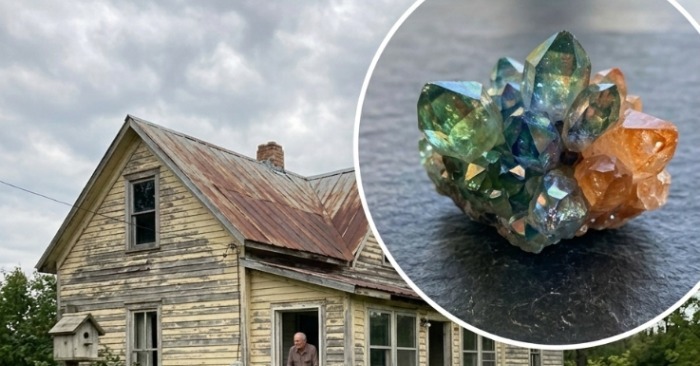
When my son came home holding a stone that glittered like a real diamond, I assumed it was nothing more than a child’s imagination at work. I had no idea that moment would lead us into an abandoned basement and put us face-to-face with a secret powerful enough to change our lives.
My name is Iris, I’m 32 years old, and for the past five years my life has revolved around only two people — me and my son.
When my husband, Carlisle, died without warning, my world did not merely crack. It shattered completely. One moment, I was a wife arguing with her husband over whose turn it was to take out the trash, and the next, I was a widow standing in a hospital hallway that smelled of antiseptic and heartbreak.
Back then, Tristan was only eight.
Now he is thirteen. Taller. Quieter. He watches me more than he realizes I notice.
Ever since Carlisle died, I have done everything I can to give my son some sense of stability. I work long hours in the hospital billing department. I pick up extra shifts whenever someone calls in sick or fails to show up.
Sometimes I make Tristan’s lunch in the middle of the night, rubbing my tired eyes and reminding myself that this is what strong mothers do. I try my hardest to make sure he never feels the full weight of everything we have lost.
But children feel everything.
Some afternoons, I catch him staring at the empty armchair that used to be his father’s favorite spot. He says nothing. Neither do I.
That afternoon began like any other. I had just gotten home from a double shift. My feet were aching. I had started reheating leftover soup when the front door burst open.
“Mom, look what I found!”
Tristan rushed into the kitchen, his dark hair windblown and his cheeks red from running. His eyes were shining in a way I had not seen in a long time.
In his hand, he was holding a small transparent stone.
It caught the light in a way that made my breath stop for a second. The kitchen lamp reflected through it, scattering tiny flashes across the cabinets. I do not know much about gemstones, but it looked… real.
I slowly wiped my hands and stepped closer.
“Where did you get that?” I asked carefully.
He smiled, proud and excited.
“Mom, there are more where I found it.”
There are moments when parental delight turns into fear in less than a second. My stomach tightened.
“Where exactly?”
“In the basement of that abandoned house two blocks from here. I can show you.”
My heart dropped.
That house had been empty for as long as we had lived in the neighborhood. Its windows were boarded up. The paint was peeling. On Halloween, teenagers dared each other to throw rocks at it. I had warned Tristan more than once to stay away from it.
“You went inside?” I tried to keep my voice calm.
He shifted his weight from one foot to the other.
“Just to look around. It’s not that scary, Mom.”
Not that scary.
I pressed my lips together.
I wanted to scold him. I wanted to ground him for a month. But the stone in my hand felt heavy. Significant.
Every instinct I had told me to say no. But curiosity — and maybe desperation too — won.
We had been barely getting by for years. Rent kept rising, groceries got more expensive every month. There were school trips I quietly turned down because I simply could not afford them. If these stones were real, even one of them could change everything.
“Fine,” I said at last. “We’re going together.”
His smile came back instantly.
“Really?”
“Yes. And afterward, we are going to have a very serious conversation about abandoned houses.”
He nodded quickly and was already halfway to the door.
The walk was short, but those two blocks felt like two miles. The sky had darkened, and the air smelled like rain. I kept glancing at Tristan, noticing how much his legs had grown, how his shoulders were starting to broaden — just like Carlisle’s had at the same age.
The house looked even worse up close.
The boards over the windows were cracked.
The front door hung crooked on its hinges. We stepped inside carefully. It smelled like dust and rot. The old wood groaned under our feet.
“Stay close to me,” I whispered.
He nodded and led me toward the basement stairs as though he had rehearsed this moment.
The steps creaked beneath our weight. I gripped the railing tightly, trying not to imagine it collapsing. Down below, the air was colder. Damp. The shadows clung to the corners.
Tristan walked confidently to one wall, reached behind a loose brick, and pulled it out.
“See?” he said.
Inside the hollow space behind it were more stones.
They sparkled even in the weak light.
For a moment, I could not breathe.
There were at least six. Maybe more. Their edges were rough, but they were transparent. Clear. They did not look like ordinary rocks.
My heart started pounding so loudly I thought Tristan might hear it.
“Don’t touch anything else,” I whispered, kneeling beside him.
He watched me closely, his excitement already mixing with confusion.
“Mom, do you think they’re worth anything?”
I swallowed.
“I don’t know.”
But I was already imagining paying off debts. Fixing the car. Maybe even moving somewhere with a yard.
The basement was too quiet.
Then I heard it.
Footsteps.
Slow. Heavy. Right at the top of the basement stairs.
My whole body went rigid.
Tristan’s eyes widened.
“Mom?”
“Stay behind me,” I whispered.
The steps creaked once. Then again.
Someone had just entered the basement behind us.
I rose slowly, my heart hammering in my chest. The stones lay exposed in the hollow brick, gleaming like secrets that were never meant to be found.
A shadow stretched across the wall before I saw the person clearly.
My mouth went dry.
The only thing I could think was that I had brought my 13-year-old son into danger because I had let greed overpower fear.
The next stair groaned under someone else’s weight.
I grabbed Tristan’s hand and turned slowly.
Halfway down the stairs stood a tall man. He looked to be somewhere in his forties, maybe fifties.
He wore a worn leather jacket and heavy work boots that scraped against the wood as he descended. His hair was graying, and his face was marked by years of exhaustion and sleepless nights.
He stopped when he saw us.
For a few seconds, nobody spoke.
Then his gaze drifted to the loose brick and the hollow space behind it.
“You shouldn’t be here,” he said quietly.
His voice did not sound angry. It was calm. And somehow, that made it more frightening.
I pulled Tristan farther behind me.
“This house is abandoned,” I replied, trying to sound steady. “We weren’t doing anything wrong.”
The man stepped off the last stair onto the basement floor.
“Abandoned doesn’t mean empty.”
Tristan’s fingers dug into the back of my sweater. I could feel how frightened he really was.
“We found these,” he blurted, pointing at the stones. “We didn’t know they were yours.”
The man looked at my son for a long moment. Something in his expression softened.
“My name is Noel,” he said at last. “And yes — they’re mine.”
My heart sank, even though part of me had already known it.
“I’m Iris,” I answered carefully. “And this is my son, Tristan. He’s thirteen.”
Noel nodded once.
“You need to leave.”
I swallowed and looked back at the stones.
“What are they?”
He hesitated.
“Uncut diamonds,” he said finally.
The word hung in the air between us like broken glass.
Diamonds.
My pulse pounded in my ears. I felt Tristan go still behind me.
“You’re lying,” he whispered.
Noel gave a tired smile.
“I wish I was.”
My thoughts were racing. Uncut diamonds hidden behind a loose brick in an abandoned house two blocks from our home. Everything felt unreal, as if we had wandered into the middle of a crime drama instead of an ordinary afternoon.
“Why are they here?” I asked.
Noel looked around the basement as if the walls might answer for him.
“Because I didn’t know what else to do with them.”
“That doesn’t explain much.”
He sighed.
“I used to work in the mines. Out west. Small company, private investors. We found a deposit that was never reported. The company tried to bury it. Some of us took samples… as insurance.”
“That sounds illegal,” I said softly.
“It is,” he admitted.
Silence settled again.
Tristan leaned closer to me.
“Mom, we need to go.”
He was right. Every protective instinct in me was screaming to get out.
But something about Noel’s posture caught my attention.
He did not look dangerous.
He looked worn out. Cornered.
“Why are you hiding them here?” I pressed.
Noel rubbed a hand over his face.
“Because most nights I sleep in my truck. This place is quiet. Nobody comes here.”
“You just told us we shouldn’t be here,” I pointed out.
A flicker of irritation crossed his face.
“And you shouldn’t.”
I took a slow breath.
“Are you planning to sell them?”
He hesitated.
“Yes. I needed money for my daughter’s treatment.”
That changed everything.
“How old is she?” I asked quietly.
“Ten,” he said. “Leukemia.”
The basement no longer felt like the setting of a crime story. It felt more like a place where three desperate adults were standing on different edges of the same cliff.
I remembered Carlisle in his hospital bed. I remembered the bills arriving before the condolences had even stopped. Grief and money problems had become so tangled together that after a while, I no longer knew where one ended and the other began.
“Why not go to the police?” I asked carefully.
He let out a humorless laugh.
“And tell them I took undeclared diamonds from a mine? That’s not likely to end well.”
I looked at Tristan.
The fear had faded from his face. Something else had replaced it.
Concern.
“Mom,” he said quietly, “we can’t just take them.”
His words pierced me because for a split second, I had thought exactly that.
I imagined slipping a few into my pocket. Selling one in secret.
No one would ever know.
But I would.
And so would my son.
Noel’s gaze moved between us.
“You can turn me in,” he said. “I wouldn’t blame you.”
I looked him straight in the eye.
“We’re not here to ruin your life.”
He studied me carefully.
“We came because my son was excited,” I continued. “We didn’t know what these were. The last few years haven’t been easy for us either.”
Noel nodded slowly.
“They haven’t been easy for me either.”
The weight of those simple words settled deep inside my chest.
“Here’s what’s going to happen,” I said after a long pause. “We’re leaving. We were never here. But you need to find a legal way to deal with this. If those diamonds can be traced, trying to sell them could land you in prison. Your daughter needs you.”
He looked at the stones, then back at me.
“I know someone,” I added carefully. “A lawyer who volunteers at the hospital. He handles complicated cases. Maybe he could give you anonymous advice.”
Noel frowned.
“Why would you help me?”
Because once, someone helped me fill out financial aid forms when I was too numb to think.
Because strangers brought food and left it on my porch without asking for anything in return.
Because I learned that survival should not depend on luck alone.
But I did not want to explain all of that to a man I had only just met.
“Because your daughter is fighting for her life and she needs her father,” I said.
For a moment, I thought he might cry.
Instead, he gave one sharp nod.
“Okay. Give me the number.”
I wrote it on the back of an old receipt from my purse and handed it to him.
“Thank you,” he said, his voice rough.
Tristan stepped forward slightly.
“You should move them somewhere safer,” he said. “Loose bricks are kind of obvious.”
Noel actually smiled.
“I’ll keep that in mind.”
We backed away slowly toward the stairs.
I did not turn my back on him until we reached the top.
Outside, the air felt lighter, even though my legs were trembling.
We walked in silence for almost a full minute.
Then Tristan finally spoke.
“They really were diamonds.”
“Yes.”
“We could have taken one.”
I looked at him.
“We could have.”
He watched me closely.
“But we didn’t.”
“No,” I said firmly. “We didn’t.”
He nodded, and I saw something shift in him. A quiet understanding. A step closer to becoming the kind of man his father would have wanted him to be.
That evening, after dinner, Tristan sat at the kitchen table doing his homework. I watched him for a while, thinking about how close we had come to making a different choice.
“I’m proud of you,” I told him.
He looked up.
“For what?”
“For knowing what was right.”
He shrugged, a little embarrassed.
“You taught me.”
Maybe I had.
Or maybe hardship had.
Later, when I lay down in bed, I realized something. At first, the diamonds had looked like a miracle. A secret door that could lead us out of our troubles. But real stability is not built on hidden stones and risky choices.
It is built on trust. Integrity. On teaching your 13-year-old son that desperation does not justify dishonesty.
Our bills were still there. The early shifts were still waiting for me. Life had not changed by magic.
But something else had changed.
That afternoon in the dusty basement, I understood clearly what kind of person I wanted to be. Not a woman who lunges toward glittering shortcuts, but a mother who stays steady even when temptation sparkles in the dark.
And for the first time in a very long while, I was certain that Tristan and I were going to be all right.
But one real question remains: when temptation shines in your hands and desperation whispers in your ear, what kind of person do you choose to be? And when your child is watching and learning from every move you make, how do you prove that integrity is worth more than any hidden treasure?