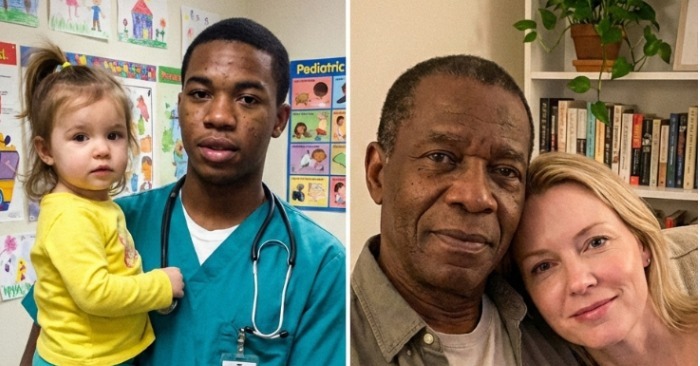
Thirteen years ago, I became a father to a little girl who lost everything in a single devastating night. I built my entire world around her and loved her as if she were my own blood. Then my girlfriend showed me something that shook me to my core, and I had to choose between the woman I thought I would marry and the daughter I had raised.
The night Avery came into my life, I was 26 and working the night shift in the ER. I had graduated from medical school six months earlier and was still learning how to keep my composure when chaos erupted around me.
Nothing prepared me for the accident that came through the doors just after midnight.
Two stretchers. White sheets already pulled over faces. And a third — holding a three-year-old girl with wide, terrified eyes searching for something familiar in a world that had just fallen apart.
Her parents had died before the ambulance reached us.
I wasn’t supposed to be the one who stayed with her. But when the nurses tried to take her to a quieter room, she grabbed my hand with both of hers and refused to let go. She squeezed so tightly I could feel her pulse through her fingers.
“My name is Avery. I’m scared. Please don’t leave. Please…” she repeated over and over, as if saying it enough times would keep me from disappearing too.
I sat beside her. Brought her apple juice in a spill-proof cup. Read her a book about a lost bear who finds his way home. She made me read it three times because it had a happy ending, and maybe she needed to hear that happy endings still existed.
When she touched my badge and said, “You’re the good one here,” I had to step into the supply closet just to breathe.
The next morning, social services arrived. They asked if she had any relatives — grandparents, aunts, uncles.
Avery shook her head. She didn’t know phone numbers or addresses. She only knew that her stuffed bunny was named Mr. Hops and that the curtains in her bedroom were pink with butterflies.
And she knew she wanted me to stay.
Every time I tried to leave the room, panic flashed across her face. As if her brain had learned in one brutal instant that people leave — and sometimes they never come back.
“She’ll go into temporary foster care. There are no registered relatives,” the social worker said.
I heard myself respond, “Can I take her? Just for tonight. Until you decide what to do.”
“Are you married?” she asked.
“No.”
She looked at me like I’d suggested something reckless. “You’re single, you work night shifts, and you just finished residency.”
“I know.”
“This isn’t babysitting for a weekend.”
“I know that too.” I just couldn’t watch a little girl who had already lost everything be taken away by more strangers.
I signed paperwork right there in the hospital corridor.
One night became a week. A week turned into months of home visits, evaluations, parenting classes squeezed between 12-hour shifts.
The first time Avery called me “Dad,” we were standing in the cereal aisle.
“Dad, can we get the dinosaur ones?” she said — then froze, like she’d broken a rule.
I crouched down beside her. “You can call me that if you want.”
Her face crumpled with relief and something deeper — something fragile.
Six months later, the adoption was official.
I rebuilt my entire life around that child — in the real, exhausting, beautiful way that means warming chicken nuggets at midnight and making sure Mr. Hops is beside her when nightmares wake her up.
I changed my hospital schedule. Opened a college fund as soon as I could afford it. We weren’t rich, but she never had to wonder if there would be food on the table or if someone would show up to her school events.
I showed up. Every time.
At sixteen, she was sharp, funny, stubborn. She had my sarcasm and her mother’s eyes — I knew that from a single police photograph I’d seen years ago.
She was my whole heart.
Last year, I met Marissa at the hospital. A nurse practitioner — intelligent, confident, dry sense of humor. She remembered Avery’s favorite bubble tea. Offered to drive her to debate club.
After eight months, I thought maybe I could have a partner without losing what I already had.
I bought a ring and hid it in my drawer.
Then one evening, Marissa walked in looking like someone who’d just witnessed a crime. She handed me her phone.
“Your daughter is hiding something awful. Look.”
Security camera footage filled the screen. A hooded figure entered my bedroom, opened my drawer, then the safe. Inside, I kept emergency cash and Avery’s college fund documents.
The figure pulled out a stack of bills.
My stomach dropped.
“I didn’t want to believe it,” Marissa said. “But she’s been acting strange lately.”
“Avery wouldn’t do this,” I whispered.
“You’re blind when it comes to her.”
That stung.
I went upstairs. She was at her desk, headphones in, working on homework.
“Avery, have you been in my room while I was gone?”
Her smile faded. “What?”
“Something’s missing from my safe.”
Confusion flashed across her face. Then hurt. Then anger.
“Are you accusing me?”
“I don’t want to. But I saw someone in a gray hoodie.”
She froze — then opened her closet.
“My gray hoodie. It’s been missing for two days.”
My blood ran cold.
I went back downstairs.
“Her hoodie is missing,” I told Marissa.
She didn’t react.
Then I asked, “What access code was entered on the footage?”
Silence.
And suddenly I remembered — how she’d insisted on installing the camera. How she’d joked about the safe.
I opened the app and rewound further.
There she was — Marissa in the hallway, holding Avery’s gray hoodie.
Then in my bedroom. Opening the safe. Lifting the cash toward the camera with a small, satisfied smile.
I turned the phone toward her. “Explain.”
Her face drained of color — then hardened.
“I was trying to save you.”
“By framing my daughter? By stealing?”
“She’s not your real daughter,” Marissa snapped.
There it was.
“She’s not your blood. You’re pouring your life into her. For what? So she can leave at eighteen?”
Everything inside me went still.
“Get out.”
She laughed bitterly. “You’re choosing her again.”
“Get out. Now.”
She pulled the ring box from her bag.
“I knew it.”
I took it from her hand and opened the door.
She left.
Avery stood halfway down the stairs. She’d heard everything.
“Dad… I didn’t want—”
“I know, sweetheart. I know.”
I pulled her into my arms.
“I’m sorry I even doubted you. No job, no woman, no money is worth more than you.”
The next day, I filed a police report. And I notified hospital administration.
Yesterday, Marissa texted: “Can we talk?”
I didn’t respond.
Instead, I sat with Avery at the kitchen table and showed her the statement from her college fund.
“This is yours. You are my responsibility. You are my daughter.”
She squeezed my hand.
Thirteen years ago, a little girl decided I was “the good one.” I can still be exactly that — her dad, her safe place, her home.
Family isn’t blood. It’s a choice. Showing up. Staying. Choosing each other every single day.
Avery chose me that night in the ER.
And I choose her every morning.
That’s love. Not perfect. Not easy. But real and unshakable.
What do you think comes next for them? Share your thoughts in the Facebook comments.
And here’s another story — about a man who raised his newborn blind daughters alone after his wife abandoned them.